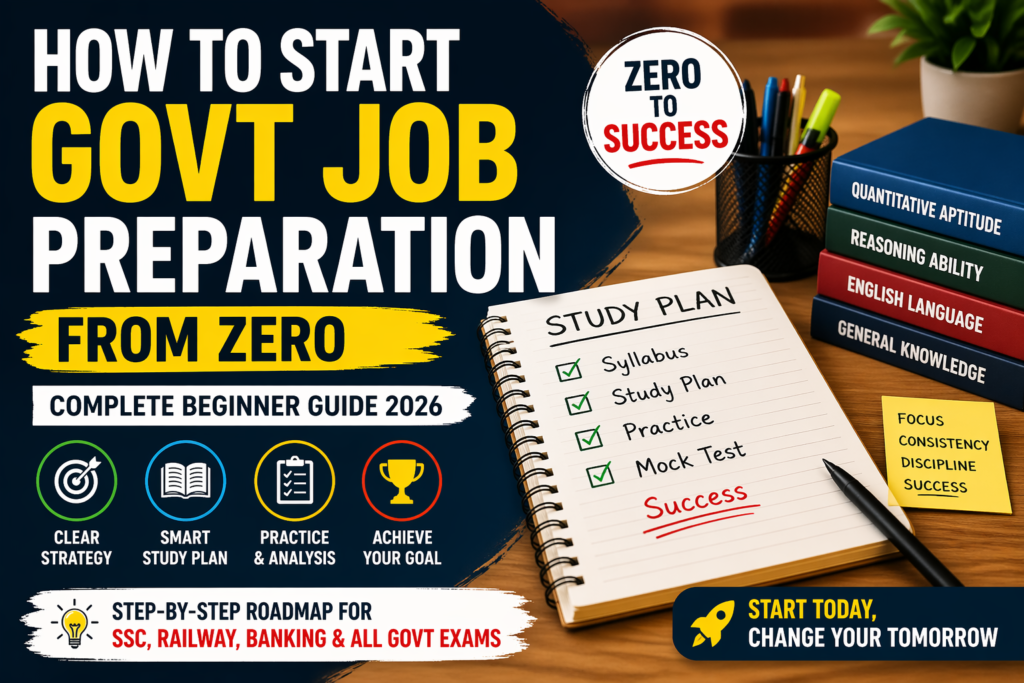
SSC Maths Preparation 2026 is the ultimate key to unlocking your dream government job this year.
If you are feeling completely overwhelmed by the vast quantitative aptitude syllabus, you are definitely not alone. Math is the section that gives maximum anxiety to beginners, but it is also the highest-scoring subject.
Many aspirants struggle with calculations and formulas, but with the right strategy, you can easily score full marks. This comprehensive guide will walk you through exactly how to study, practice, and conquer the math section.
By following these expert tips, you will build unshakeable confidence and tackle even the toughest exam questions. Let us dive into the ultimate blueprint for your success!
Why is SSC Maths Preparation 2026 So Crucial?
When it comes to Staff Selection Commission exams, quantitative aptitude is the ultimate deciding factor for your final merit ranking. Whether you are aiming for CGL, CHSL, MTS, or CPO, your math score dictates your success.
While General Awareness can be unpredictable, Math relies entirely on logic, concepts, and your own hard work. If you prepare thoroughly, you can predict your score with incredible accuracy.
Securing a 45+ score out of 50 in Tier 1 is highly achievable if you stick to a structured plan. Let’s break down the core components you need to conquer.
Decoding the Syllabus
Before buying any books or starting your timers, you must understand exactly what the commission expects from you. The official syllabus is your holy grail.
You can always download the latest official notifications and syllabus directly from the Staff Selection Commission (SSC) official website. Read through the quantitative aptitude section word by word.
Highlight the topics you are completely unfamiliar with. This initial syllabus breakdown will help you create a personalized study timetable that actually works.
Arithmetic vs. Advance Math
The SSC quantitative aptitude section is broadly divided into two major categories: Arithmetic and Advance Math. Both hold almost equal weightage, but they require entirely different approaches.
Arithmetic deals with real-world concepts like Percentages, Profit and Loss, Time and Work, and Simple/Compound Interest. It tests your logical understanding and calculation speed.
Advance Math includes Algebra, Geometry, Trigonometry, and Mensuration. This section is heavily formula-based and relies on your knowledge of theorems and properties. You must balance both to succeed.
7 Powerful Tips for Your SSC Maths Preparation 2026
If you want to outshine millions of other candidates, you need to study smarter, not just harder. Implementing a strategic approach is mandatory.
Here are the seven most effective, field-tested strategies to elevate your SSC Maths Preparation 2026 to the next level.
1. Master the Basics Before Chasing Tricks
The biggest mistake beginners make is jumping straight into YouTube shortcut tricks without understanding the underlying concepts. Tricks will fail you if the examiner tweaks the question slightly.
Start by clearing your foundational concepts. If your basics are weak, refer to the NCERT Official Textbooks for classes 8 to 10 to rebuild your core understanding.
Once you know the “why” behind a mathematical process, you can effortlessly apply the “how” (the shortcut). A strong foundation ensures accuracy under immense exam pressure.
2. Time Management is the Ultimate Game Changer
In the SSC Tier 1 exam, you get a combined 60 minutes to solve 100 questions across four subjects. This means you have roughly 15 to 20 minutes to solve 25 math questions.
You cannot afford to spend 3 minutes on a single tricky question. You must learn the art of skipping difficult questions during your first pass through the exam.
Practice solving easier questions within 30 seconds. Build your rhythm so you can save precious time for the lengthier calculation-heavy problems at the end.
3. Rigorously Solve Previous Year Questions (PYQs)
The SSC is famous for repeating question patterns, concepts, and sometimes exact questions from previous years. PYQs are the most valuable resource in your entire arsenal.
Collect question papers from the last 4-5 years, especially since the vendor (like TCS) shifted the pattern to be more calculative. Treat these papers as your daily homework.
By solving PYQs, you will understand the exact language the examiner uses. It removes the element of surprise on the actual exam day.
4. Take Regular Mock Tests and Quizzes
Reading math is a completely different ballgame than actually solving it under a ticking clock. Mock tests simulate the intense pressure of the real exam environment.
Start with sectional math mocks to build your subject-specific stamina. Gradually transition to full-length mocks once you have covered 70% of the syllabus.
Aim to give at least two full-length mock tests per week in the beginning, increasing the frequency as the exam date approaches.
5. Maintain a Dedicated Formula Copy
Advance Math requires you to memorize hundreds of formulas, identities, and geometric theorems. Relying on your memory without a written record is a massive risk.
Buy a fresh, thin notebook and turn it into your ultimate “Formula Copy.” Write down every new formula, important theorem, and unique shortcut you learn during practice.
Revise this notebook every morning for just 15 minutes. By the time your exam arrives, every formula will be permanently hardwired into your brain.
6. Skyrocket Your Calculation Speed
Examiners nowadays love to trap students with basic questions that involve annoying decimals and massive fractions. If your calculation speed is slow, you will lose the race.
You must memorize multiplication tables up to 30, squares up to 50, and cubes up to 20. Additionally, memorize fractional values of percentages (e.g., $16.66\% = \frac{1}{6}$).
Dedicate exactly 15 minutes every day purely to random calculation practice. Use mobile apps or write random 3-digit numbers and multiply them manually.
7. Deeply Analyze Your Mistakes
Giving a mock test is only 30% of the job; the remaining 70% lies in the analysis. If you do not analyze your mistakes, you will continue repeating them.
After every test, spend an hour reviewing the math section. Identify whether a mistake was due to a silly calculation error, a conceptual gap, or poor time management.
Keep a separate “Mistake Journal” to note down the specific traps you fell into. Review this journal before your next mock test to ensure continuous improvement.
Best Books for SSC Maths Preparation 2026
Having too many books creates confusion. You only need a couple of highly trusted resources to ace the quantitative aptitude section.
For clearing your basic concepts, Rakesh Yadav’s Class Notes is an excellent starting point. It breaks down complex Arithmetic and Advance topics into easily digestible segments.
For rigorous practice, you must rely on a chapter-wise compilation of previous year questions. Books by Kiran Publications or Pinnacle are highly recommended for this purpose.
Stick to a maximum of two books and revise them multiple times. Remember, reading one book ten times is infinitely better than reading ten books once.
(Need tips for the English section too? Check out our related guide: Mastering SSC English 2026: A Complete Strategy)
Conclusion
Acing the quantitative aptitude section requires consistency, patience, and a highly strategic approach. By strictly following this SSC Maths Preparation 2026 guide, you will drastically improve your accuracy and speed.
Remember to master your basics, aggressively solve previous year questions, and never skip your mock test analysis. The journey might seem tough initially, but your daily efforts will compound into massive success.
Are you ready to start your preparation journey today? Drop a comment below with the math topic you find the most difficult, and don’t forget to bookmark this guide for your future reference!